
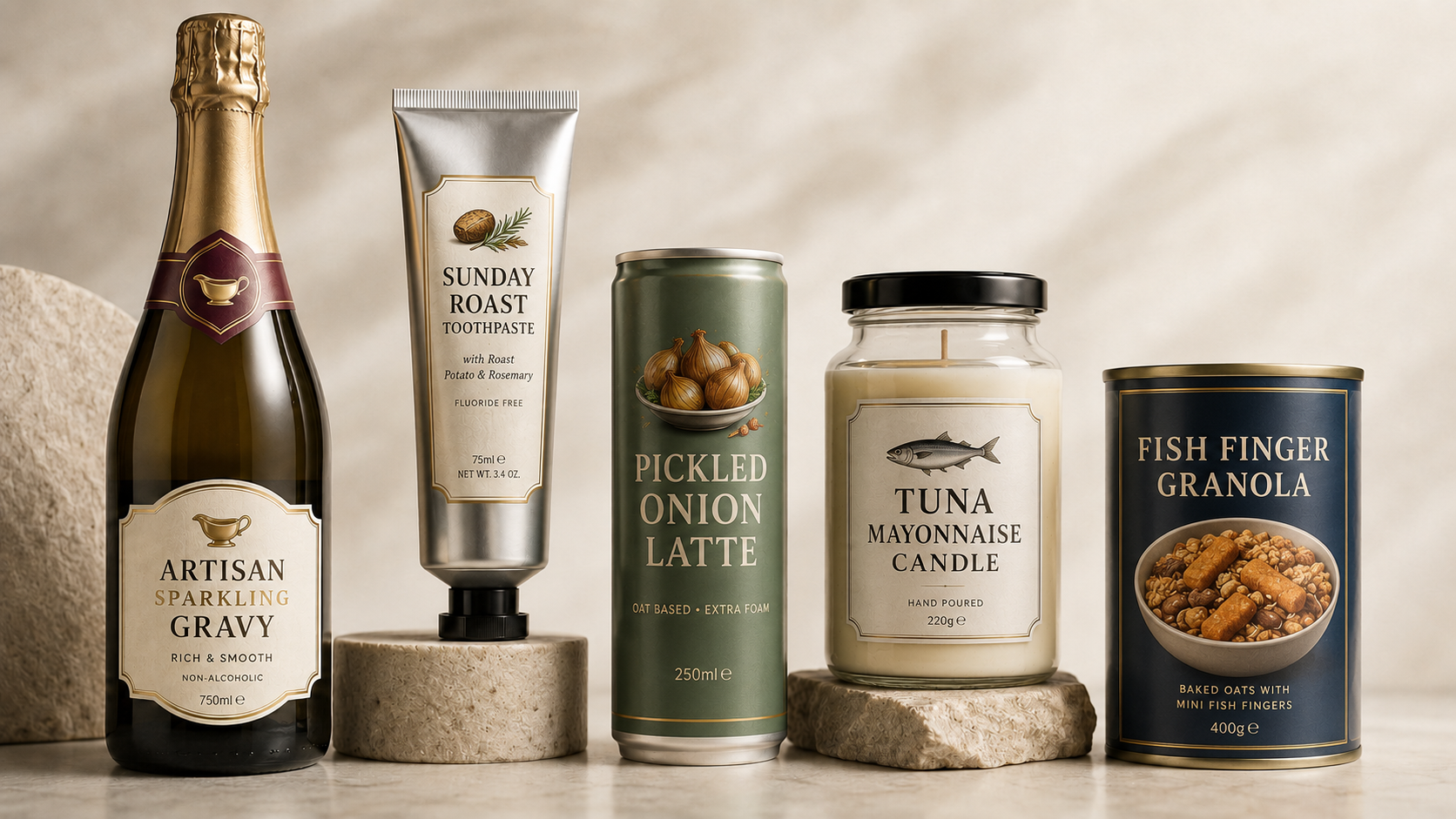
Artisan Sparkling Gravy. Rich, comforting and lightly carbonated.
It looks premium. The packaging is beautiful. Someone, somewhere, has already suggested a truffle edition.
There’s just one rather important question: does anybody actually want it?
According to NielsenIQ, more than 80% of FMCG product launches fail. That’s a fairly expensive way to discover that people didn’t understand the proposition, wouldn’t pay the price, couldn’t see how the product fitted into their lives or thought the packaging looked like something their nan would keep plasters in.
Market research can’t guarantee that a new product will succeed. What it can do is expose the assumptions, unanswered questions and potential problems before you’ve committed the campaign budget and ordered 40,000 units.
And a slightly bruised idea is considerably cheaper than a failed launch.
There’s rarely one dramatic, boardroom-silencing reason. More often, it’s a collection of smaller issues that weren’t picked up early enough.
The product might solve a problem that isn’t especially important to its intended audience. The concept could be strong, but the proposition unclear. The price might feel out of step with the perceived value, while the packaging may attract attention for all the wrong reasons.
Sometimes, the product itself is perfectly good but struggles because the wrong audience has been targeted, the messaging doesn’t land or the launch takes place in a category that has already moved on.
NielsenIQ highlights several factors that can affect FMCG growth strategies, including limited visibility of category performance, insufficient understanding of competitor products, unsuitable retail channels and pricing that falls outside what buyers are prepared to pay.
None of those problems is particularly mysterious after a product has failed. The trick is finding them while you can still do something about them.
Market research for product development should not be a final thumbs-up exercise carried out once every important decision has already been made.
Used properly, it gives teams evidence at several points in the development process. It can help shape the original opportunity, refine the product concept, explore purchasing behaviour and test how the final proposition will perform in the real world.
The precise approach depends on the product, category and stage of development, but product launch research might explore:
This doesn’t mean asking a room full of people, “Do you like our idea?” and waiting hopefully.
People are generally polite. Stakeholders are generally invested. Neither is especially useful if the research has been designed to confirm a decision rather than challenge it.
Good new product development research explores why people respond as they do, what they compare the product with and whether their stated enthusiasm is likely to translate into real behaviour.
Concept testing allows brands to explore an idea before significant time and budget have been committed to developing it.
Participants might be shown different propositions, product benefits, names or use cases. The research can then examine which elements are compelling, which cause confusion and what consumers believe they are being offered.
This is where teams often uncover the gap between the product they think they have created and the one the audience thinks they are looking at.
If a concept takes six paragraphs and a diagram to explain, that’s useful information. If consumers like the general idea but cannot see when they would use it, that is too.
It doesn’t necessarily mean the concept should be abandoned. It may need to be simplified, repositioned or aimed at a different audience. Finding that out early gives you options.
Once the concept has progressed, product testing can explore how well the experience delivers against expectations.
Depending on the category, this may involve testing taste, usability, performance, format, portion size, scent, texture or other product characteristics. Qualitative research can uncover detailed reactions and behaviours, while quantitative research can help measure and compare responses across a larger sample.
Crucially, product testing should be considered alongside the proposition. A premium claim creates premium expectations. A convenience product needs to feel genuinely convenient. If the experience does not deliver what the messaging promises, a polished campaign will only help more people become disappointed by it.
Packaging has quite a lot to do at once. It needs to attract attention, communicate what the product is, convey the right level of quality and help somebody choose it in a busy physical or digital environment.
Packaging research can explore visibility, comprehension, brand fit and standout. It can also reveal unintended associations which may be obvious to consumers but completely invisible to the people who have spent six months reviewing slightly different shades of blue.
The prettiest design in the presentation is not necessarily the one that will work hardest on the shelf.
Testing packaging with the intended audience helps brands understand not just which option people prefer, but what each design communicates and whether the important information is noticed quickly enough.
There is a sizeable difference between liking a product and buying it.
Pricing research helps explore perceived value, acceptable price ranges and the trade-offs consumers make when choosing between products. It can also identify whether a lower price would weaken perceptions of quality or whether a premium position is unsupported by the proposition.
Price should therefore be tested in context. Consumers do not assess it in isolation; they compare it with familiar products, alternative ways of meeting the same need and the amount they believe the purchase is worth to them.
Asking “Would you pay £5 for this?” may provide an answer. Exploring what makes it feel worth £5 provides far more useful consumer insight.
There will always be uncertainty in a product launch. Consumer behaviour changes, competitors move, retailers make decisions and occasionally the market simply refuses to cooperate.
Market research is not a crystal ball, and anyone promising guaranteed success should probably be kept away from both the research budget and the sparkling gravy.
What research offers is a better basis for making decisions. It lets teams test assumptions with the people they expect to buy the product, understand the reasons behind their reactions and improve the idea while improvement is still relatively painless.
Sometimes the research will validate the direction. Sometimes it will identify a few manageable changes. Occasionally, it will tell you that the entire idea needs another look.
That last outcome might not feel like good news in the debrief, but it can be extremely valuable news for the business.
A successful launch involves more than having a good idea. The proposition needs to be understood, the product needs to deliver, the packaging needs to communicate and the price needs to feel justified.
That is a lot to leave to instinct.
Acumen Fieldwork helps research teams and brands speak to the right people throughout the product development process, from early concept testing to product, packaging, pricing and messaging research.
Planning a new product launch? Let us help you find the holes before the market does. We promise to give the sparkling gravy a fair hearing.



At the start of a research project, representation can look quite simple. A sample spec […]
READ MORE
The Brief A global research agency partnered with Acumen to recruit participants for a series […]
READ MORE
There’s a quiet irony in research and it’s that the quality of what you get […]
READ MORE